

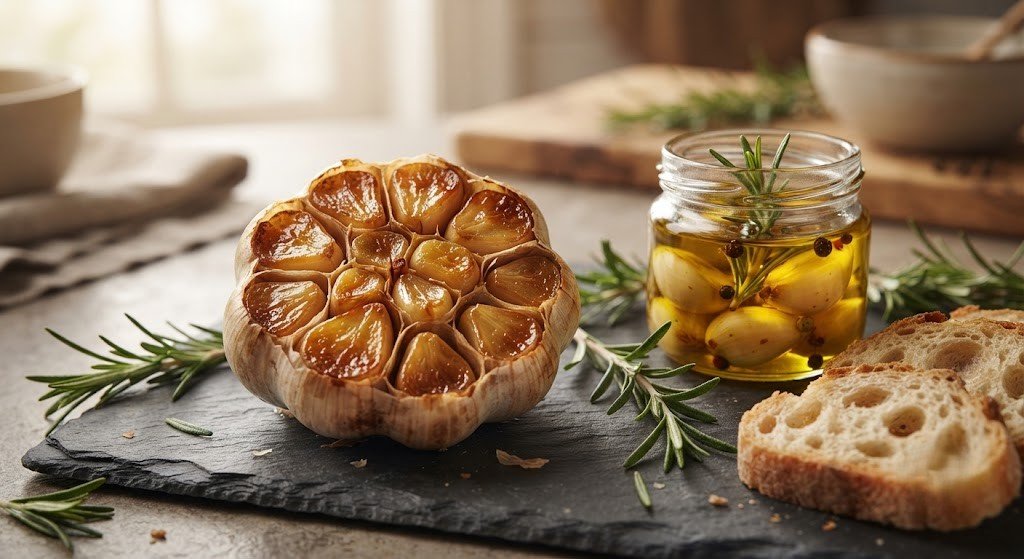
Raw garlic possesses a sharp, pungent bite that can quickly overwhelm a dish. However, applying gentle heat transforms those sulfurous, sharp compounds into a soft, buttery, and intensely sweet spread. Understanding how to roast garlic at home unlocks one of the most versatile flavor bases in traditional and modern cooking.
While traditional oven-roasting whole bulbs remains the most popular approach, low-temperature poaching—known as garlic confit—offers an equally luxurious, oil-rich alternative. Both methods deliver incredible depth of flavor, but each relies on distinct scientific principles, cooking times, and storage considerations.
Key Takeaways
- Chemical Transformation: Roasting breaks down allicin (the compound responsible for raw garlic’s sharpness) into complex sugars through caramelization and the Maillard reaction.
- Whole Bulb Roasting: High-heat dry baking ($400^\circ\text{F}$ / $200^\circ\text{C}$) in aluminum foil creates rich, deeply caramelized, spreadable cloves with minimal cleanup.
- Garlic Confit: Low-heat wet poaching ($200^\circ\text{F}$–$250^\circ\text{F}$ / $95^\circ\text{C}$–$120^\circ\text{C}$) in excess oil yields ultra-tender peeled cloves alongside an exceptionally flavorful infused garlic oil.
- Storage & Safety: Whole roasted garlic lasts up to 2 weeks in the fridge, while garlic confit must be refrigerated strictly at $40^\circ\text{F}$ ($4^\circ\text{C}$) or below and consumed within 4 days to eliminate botulism risks.
The Science of Garlic Roasting: Heat, Allicin, and Sugar
When raw garlic cloves are crushed or bitten, an enzyme called alliinase converts alliin into allicin. Allicin is the chemical compound that gives raw garlic its pungent aroma and burning taste.
Subjecting garlic to prolonged heat deactivates the alliinase enzyme and breaks down tough cell walls. As the internal temperature rises above $285^\circ\text{F}$ ($140^\circ\text{C}$), the naturally occurring carbohydrates in the bulb break down into simple sugars, undergoing the Maillard reaction. This process alters both the texture and flavor profile:
- Texture: From crisp and dense to smooth, paste-like, and spreadable.
- Flavor: From sharp, biting, and acrid to sweet, nutty, and savory.
Method 1: Roasting Whole Bulbs in the Oven
Roasting whole heads of garlic is the easiest, low-effort technique for beginners learning how to roast garlic at home. The papery outer skin acts as a natural pressure cooker, keeping the cloves moist as they brown.
Step-by-Step Instructions
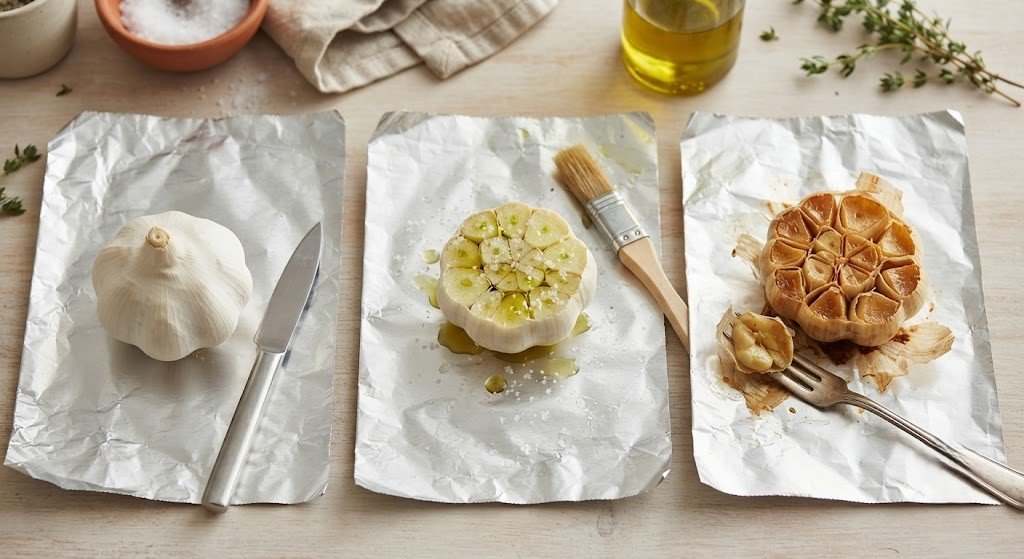
- Prep the Head: Preheat your oven to $400^\circ\text{F}$ ($200^\circ\text{C}$). Slice roughly $\frac{1}{4}$ to $\frac{1}{2}$ inch off the top stem end of the whole garlic head, exposing the tops of the individual cloves inside.
- Season and Seal: Place the trimmed bulb onto a small sheet of aluminum foil. Drizzle 1 to 2 teaspoons of high-quality extra virgin olive oil over the exposed cloves, ensuring the oil trickles down into the crevices. Sprinkle with a tiny pinch of kosher salt.
- Wrap Tightly: Crimp the aluminum foil tightly around the bulb to create a sealed pouch that traps escaping steam.
- Roast: Bake for 40 to 55 minutes. The garlic is finished when a knife inserted into the center meets no resistance, and the cloves are a deep amber-gold color.
- Extract: Allow it to cool slightly, then gently squeeze the base of the head to pop the soft roasted cloves out of their skins.
[Internal Link: Insert relevant internal URL here with anchor text: “step-by-step guide to making homemade roasted garlic butter”]
Method 2: Garlic Confit (Low and Slow in Oil)
“Confit” is a traditional French preservation technique that involves slowly cooking food in a bath of fat at low temperatures. Garlic confit requires peeling individual cloves beforehand, yielding both melt-in-your-mouth garlic and a rich, infused cooking oil.
Step-by-Step Instructions
- Prepare Cloves: Peel 2 to 3 whole heads of garlic cloves (roughly 20–30 individual cloves). Ensure no skin or root bottoms remain attached.
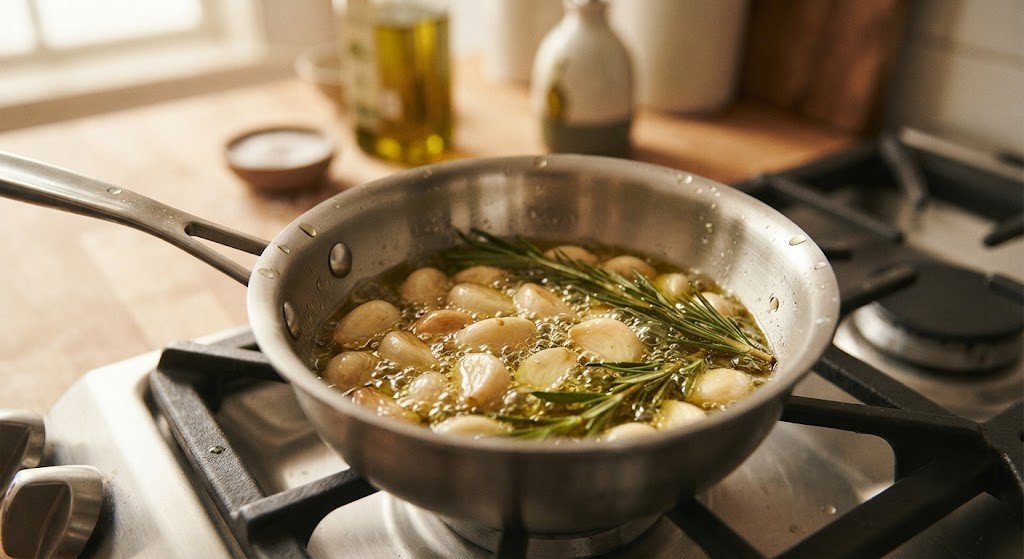
- Submerge in Oil: Place the peeled cloves into a small, heavy-bottomed saucepan or small oven-safe baking dish. Cover completely with a high-smoke-point or flavorful oil (such as extra virgin olive oil or avocado oil) until the cloves are submerged by at least $\frac{1}{2}$ inch.
- Cook Low and Slow:
- Stovetop: Heat over the lowest burner setting ($200^\circ\text{F}$ to $225^\circ\text{F}$ / $95^\circ\text{C}$ to $105^\circ\text{C}$). Simmer extremely gently for 45 to 60 minutes until the cloves are pale golden and tender. Do not let the oil boil aggressively.
- Oven: Bake uncovered at $250^\circ\text{F}$ ($120^\circ\text{C}$) for 1 to 1.5 hours.
- Cool: Remove from heat immediately to prevent over-browning or burning.
Comparing Whole Bulbs vs. Confit
Choosing between these two methods depends on how you plan to use the finished product and how much hands-on time you have.
+-------------------+-----------------------------------+-----------------------------------+
| Feature           | Whole Bulb Roasting               | Garlic Confit                     |
+-------------------+-----------------------------------+-----------------------------------+
| Primary Benefit   | Quick prep; minimal cleanup       | Yields both tender garlic & oil   |
| Prep Effort       | Low (no peeling required)         | Medium (cloves must be peeled)    |
| Cooking Temp      | High: 400°F (200°C)               | Low: 200°F–250°F (95°C–120°C)     |
| Cooking Time      | 40 to 55 minutes                  | 45 to 90 minutes                  |
| Texture & Flavor  | Deeply caramelized, nutty, paste  | Ultra-silky, delicate, buttery    |
| Shelf Life        | 1–2 weeks (refrigerated)          | 4 days (strict refrigeration)     |
+-------------------+-----------------------------------+-----------------------------------+
Crucial Food Safety: Preventing Botulism in Garlic Oil
When discovering how to roast garlic at home using the confit method, safety must take priority. Garlic is a low-acid vegetable that grows underground, making it a natural carrier for spores of Clostridium botulinum.
When peeled garlic is submerged in oil, it creates an oxygen-free (anaerobic) environment. If kept at room temperature, these conditions can allow botulism bacteria to thrive and produce deadly toxins.
Safety Guidelines for Garlic Confit:
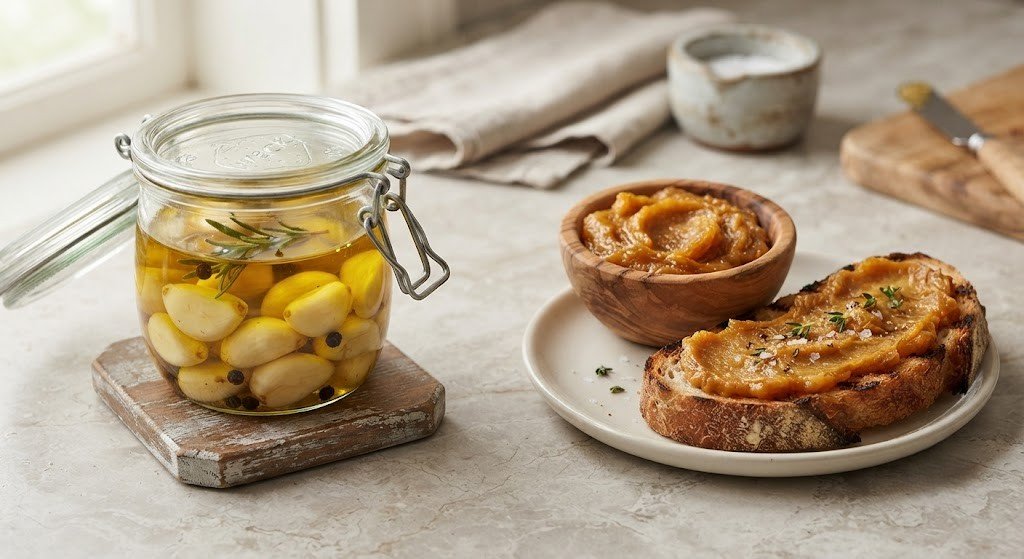
- Immediate Refrigeration: Never leave garlic confit or infused oil sitting out at room temperature. Cool it quickly and place it in an airtight glass container in the refrigerator immediately.
- The 4-Day Rule: According to food safety authorities, home-prepared garlic confit kept below $40^\circ\text{F}$ ($4^\circ\text{C}$) must be consumed or discarded within 4 days.
- Freezing for Long-Term Storage: For longer storage, freeze garlic confit and its oil in small ice cube trays or freezer-safe containers for up to 3 months.
[External Link: Insert high-authority external URL here with anchor text: “CDC guidance on home-canned foods and botulism prevention”]
Best Ways to Use Roasted Garlic & Confit
- Spreads and Dips: Mash roasted cloves into softened butter, cream cheese, or hummus for an instant flavor upgrade.
- Pasta and Sauces: Stir whole confit cloves directly into warm marinara, alfredo, or pan sauces where they dissolve effortlessly.
- Vinaigrettes: Whisk the leftover aromatic confit oil with lemon juice or red wine vinegar for a quick salad dressing.
- Crusty Bread: Spread whole roasted cloves directly onto toasted baguette slices as a simple crostini base.
Conclusion
Knowing how to roast garlic at home allows you to substitute harsh raw garlic notes with mellow, caramelized sweetness. Whether you prefer the straightforward, hands-off approach of foil-wrapped whole bulbs or the double-yield luxury of garlic confit, mastering both methods elevates your everyday cooking with minimal expense and effort. Choose your method, mind food safety storage rules, and keep a jar ready in your kitchen.
Frequently Asked Questions (FAQs)
Can I roast garlic without using aluminum foil?
Yes. If you prefer to avoid aluminum foil, you can use a small covered cast-iron garlic roaster, a small ceramic ramekin covered with a oven-safe lid or parchment paper, or a covered muffin tin.
Why did my garlic turn bitter after roasting?
Garlic turns bitter when it burns. If the oven temperature is too high, or if the cloves cook too long uncovered during confit prep, the natural sugars char and develop a acrid, unpleasant taste. Keep temps controlled and ensure whole heads are wrapped securely.
Can I roast whole garlic bulbs in an air fryer?
Absolutedly. Wrap the prepped, seasoned head of garlic in foil just as you would for oven baking, and place it in your air fryer basket at $380^\circ\text{F}$ ($190^\circ\text{C}$) for 25 to 35 minutes until soft and caramelized.