

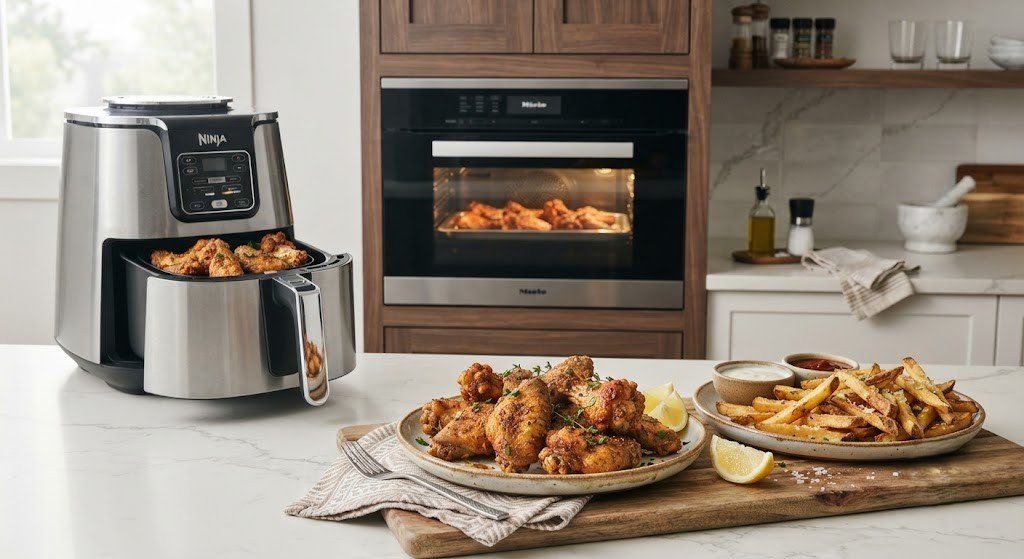
Achieving that golden, satisfying crunch without submerging food in gallons of oil is the ultimate goal of modern home cooking. When comparing the air fryer vs. convection oven, many home cooks assume they perform identically because both rely on circulating hot air. However, key structural and mechanical differences affect how rapidly moisture evaporates from food surfaces—the exact process required to create maximum crispiness.
Understanding the subtle science behind an air fryer vs. convection oven will help you select the right appliance for your kitchen space, cooking habits, and crunch expectations.
Key Takeaways
- Mechanics: Both appliances use convection heat, but air fryers feature a much smaller chamber and a far more powerful fan per cubic foot.
- Crispiness Victor: Air fryers deliver a faster, crunchier crust on smaller batches due to intense, concentrated air flow that quickly strips surface moisture.
- Capacity Advantage: Convection ovens win on volume, allowing you to crisp multiple trays of food at once without crowding.
- Preheating Speed: Air fryers reach cooking temperatures almost instantly, making them faster for quick, crispy meals and reheating.
- Best Use Cases: Use an air fryer for small-batch snacks, frozen foods, and wings; use a convection oven for sheet-pan dinners, large roasts, and baked goods.
The Science of Crispiness: How They Compare
To understand why one appliance creates a lighter, crunchier texture than the other, it helps to examine how hot air and heat transfer interact with moisture.
+------------------------+---------------------------------------+---------------------------------------+
| Feature                | Air Fryer                             | Convection Oven                       |
+------------------------+---------------------------------------+---------------------------------------+
| Air Circulation Speed  | High-velocity, focused airflow        | Moderate, wide-area airflow           |
| Chamber Size           | Compact (approx. 3-8 quarts)          | Large (approx. 2-5 cubic feet)        |
| Moisture Evaporation   | Rapid (dries surface quickly)         | Gradual (allows gentle browning)      |
| Best For               | Quick crisping, single portions, wings| Large batches, baking, sheet pans    |
+------------------------+---------------------------------------+---------------------------------------+
Crispiness relies heavily on the Maillard reaction and rapid water evaporation. When high-velocity hot air strips moisture off the food’s exterior faster than internal steam can migrate to the surface, a dry, crunchy crust forms.
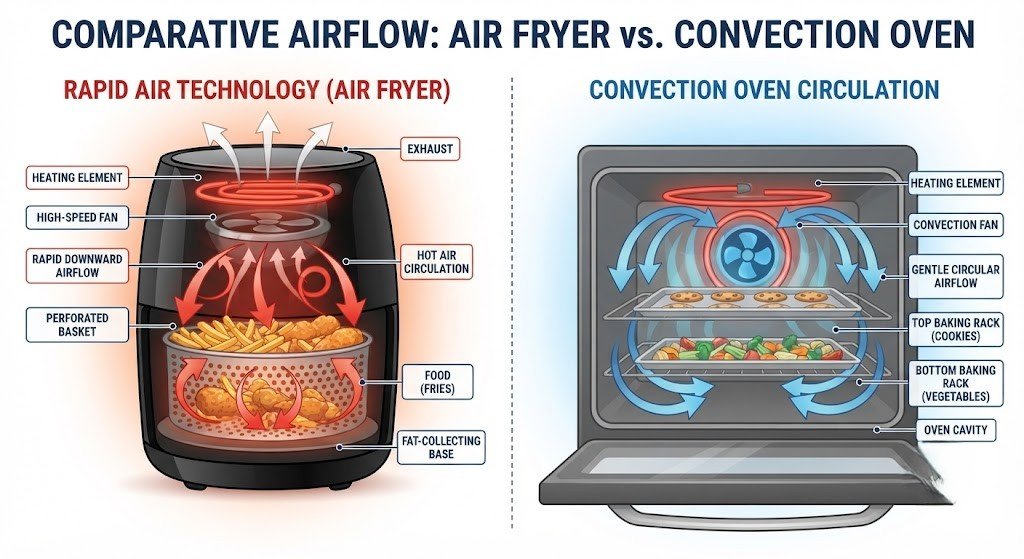
Because an air fryer packs a massive fan directly above a perforated basket in a tiny cavity, it creates a wind-tunnel effect. A convection oven circulates air gently across a vast space, resulting in even heat distribution but less intense air pressure on individual pieces of food.
Air Fryer Strengths: Why It Wins for Speed and Crunch
The direct proximity of the air fryer’s heating element to the food basket gives it a distinct edge in several key areas.
High-Velocity Air Movement
The fan in a compact air fryer spins much faster relative to the size of its cooking chamber. This aggressive circulation breaks down the boundary layer of cooler, humid air surrounding raw food, accelerating surface drying.
Perforated Baskets Allow 360-Degree Airflow
Unlike flat baking sheets, air fryer baskets feature holes or mesh bottoms. This design allows hot air to reach the underside of food constantly, preventing soggy bottoms on items like breaded chicken tenders or mozzarella sticks.
For techniques on mastering air-circulating cookers, read our guide on [Internal Link: Insert relevant internal URL here with anchor text like “essential meal prep strategies for home cooks”].
Convection Oven Strengths: Capacity and Versatility
While an air fryer achieves higher crispiness levels on smaller portions, the air fryer vs. convection oven debate isn’t one-sided. Convection ovens excel in areas where air fryers struggle.
Superior Capacity for Families
If you are cooking for a family of four or hosting dinner, an air fryer basket quickly becomes overcrowded. Stacking or overlapping food traps steam, defeating the air fryer’s primary advantage and leaving food soggy. A convection oven easily handles two full sheet pans with room for air to circulate freely.
Better Control for Delicate Foods
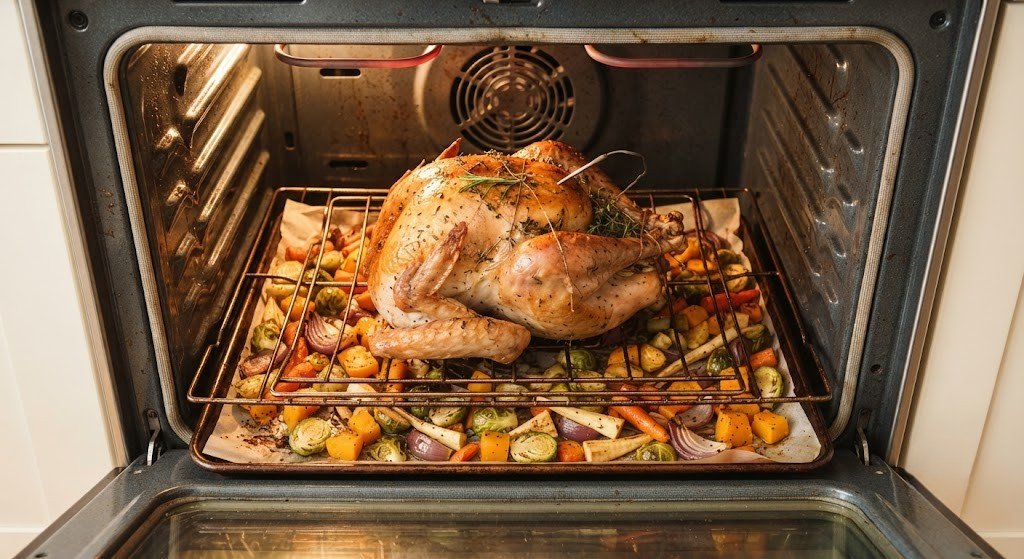
The fierce wind inside an air fryer can displace light ingredients (like delicate herbs or thin bacon) or dry out delicate baked goods. Convection ovens offer a gentler airflow that promotes even browning on cakes, cookies, and large roasts without scorching the exterior.
Conversion Guide: Adapting Recipes Between Appliances
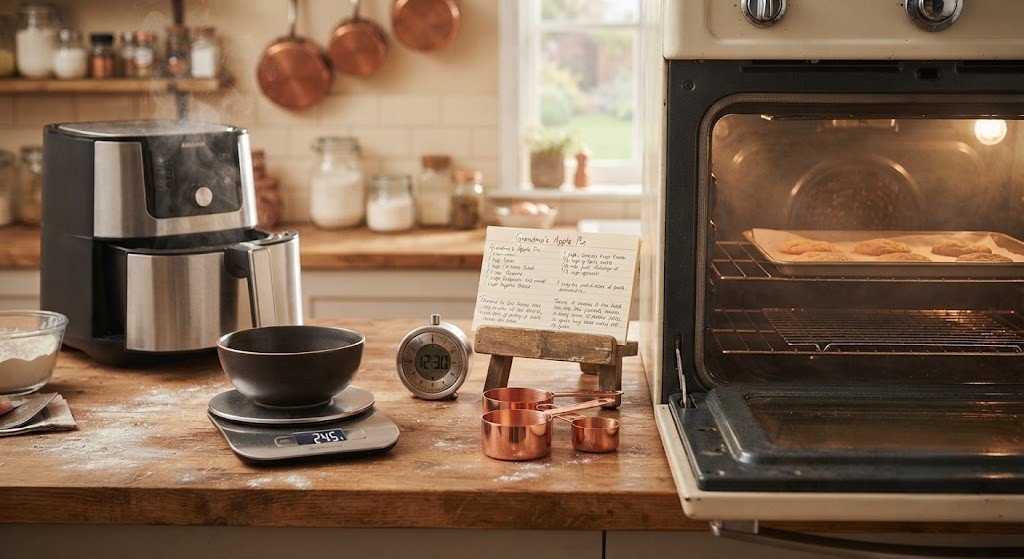
If you have a recipe written for a traditional or convection oven, adjusting it for an air fryer—or vice versa—is straightforward.
Converting Convection Oven Recipes to Air Fryer
- Reduce Temperature: Lower the set temperature by 20°F to 25°F if your air fryer heat feels intense.
- Shorten Cooking Time: Reduce overall cooking time by 15% to 20%. Start checking food early to prevent burning.
- Shake the Basket: Toss or shake the contents halfway through the cycle to reorient pieces for uniform crisping.
Converting Air Fryer Recipes to Convection Oven
- Increase Cooking Time: Expect food to take 20% to 30% longer to achieve a similar golden texture.
- Use a Wire Rack: Place food on a wire rack elevated over a baking sheet to recreate 360-degree heat exposure.
To ensure your meat reaches safe temperatures regardless of the cooking method, consult the [External Link: Insert high-authority external URL here with anchor text like “USDA Safe Minimum Internal Temperature Chart”].
Final Verdict: Which Should You Choose?
When comparing an air fryer vs. convection oven, the winner depends on your cooking style:
- Choose an Air Fryer if: You prioritize maximum crunch, cook for 1–3 people, want rapid preheating, or frequently reheat leftover fried foods.
- Choose a Convection Oven if: You cook large quantities, regularly bake multi-rack dinners, or prefer an all-in-one appliance built directly into your range.
Frequently Asked Questions (FAQs)
Can a convection oven replace an air fryer completely?
A convection oven can perform all the functions of an air fryer, but it will take slightly longer to produce the same degree of crispiness on small, breaded foods because its air circulation velocity is lower.
Why is my food not getting crispy in the air fryer?
Overcrowding the basket is the most common mistake. When food pieces touch or overlap, trapped steam builds up and prevents the surface from crisping. Cook in batches for the best results.
Do I need to use oil in an air fryer vs. a convection oven?
Both appliances require far less oil than traditional deep frying. However, a light mist of high-smoke-point oil (like avocado or canola oil) promotes uniform browning and significantly improves crispiness in both appliances.
Conclusion
In the battle of air fryer vs. convection oven, the air fryer claims the top spot for pure, rapid crispiness due to its high-speed fan and compact cooking basket. However, the convection oven remains an essential workhorse for batch cooking, baking, and family meals. Understanding how air velocity and cavity size affect heat transfer allows you to maximize the strengths of both tools in your culinary routine.